Quick Guide Summary
Level 2 EV charger installation in Houston typically costs $900 to $2,500, depending on panel capacity and wiring distance. Most residential installations take 2 to 6 hours and charge electric vehicles 5–8 times faster than standard outlets. Homes with 200-amp panels often support installation without major electrical upgrades.
Opening Information Block
| Item | Details |
|---|---|
| Quick Overview | A residential Level 2 charger provides faster EV charging using a 240-volt circuit |
| Typical Installation Time | 2–6 hours for most Houston homes |
| Estimated Cost Range | $900 – $2,500 depending on electrical work |
| Suitable Charger Types | Tesla Wall Connector, ChargePoint Home Flex, JuiceBox |
Why Houston Homeowners Are Installing Faster EV Chargers
Electric vehicles are becoming common across Texas. Many Houston drivers prefer home charging because public stations may not always be convenient. Charging overnight at home provides reliability that public infrastructure cannot always guarantee.
Standard wall outlets charge very slowly. A full battery may take more than a day to recharge using a regular 120-volt outlet. Faster charging becomes essential for commuters who drive daily.
This is where Level 2 EV Charger Installation Houston becomes valuable. A properly installed charging system can replenish most EV batteries overnight while maintaining safe electrical operation.
Home charging also improves convenience. Drivers return home, plug in their vehicle, and wake up with a ready battery the next morning.
What Is the Cost of Level 2 EV Charger Installation in Houston?
Installation cost varies based on electrical panel capacity, wiring distance, and installation complexity. Most residential installations fall within a predictable range.
| Installation Type | Typical Houston Cost |
|---|---|
| Basic garage installation | $900 – $1,200 |
| Outdoor installation with conduit | $1,200 – $1,800 |
| Installation requiring panel upgrade | $2,000 – $3,500 |
Several factors influence the final cost.
Distance between the electrical panel and charger location is one of the largest variables. Longer wiring runs increase labor and material expenses.
Permits may also affect installation cost. Permanent installations typically require electrical permits through the City of Houston Permitting Center when new circuits are added.
Local utility programs can also influence long-term costs. Many homeowners check CenterPoint Energy programs for time-of-use electricity plans that reduce overnight charging expenses.
Does My Houston Home Need a Panel Upgrade for an EV Charger?
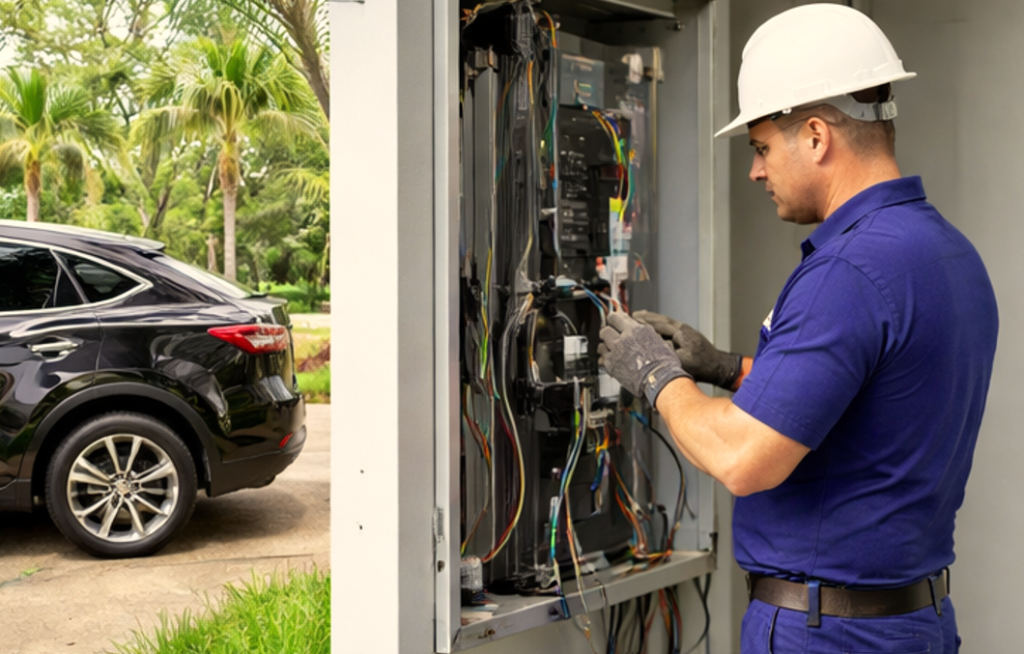
Electrical capacity determines whether a charger can be installed safely. Many modern homes have 200-amp service panels that easily support EV charging circuits.
Older homes may require additional evaluation.
Below is a simplified guideline installers often use.
| Panel Size | Recommended Charger Output |
|---|---|
| 100 amp panel | 16–24 amp charger |
| 150 amp panel | 24–40 amp charger |
| 200 amp panel | 40–48 amp charger |
Homes built before the 1990s sometimes have limited breaker capacity. In those situations electricians may install load management devices that balance electricity usage between appliances and chargers.
This prevents panel overload while allowing safe charging.
How Does Houston Humidity Affect Outdoor EV Charger Safety?
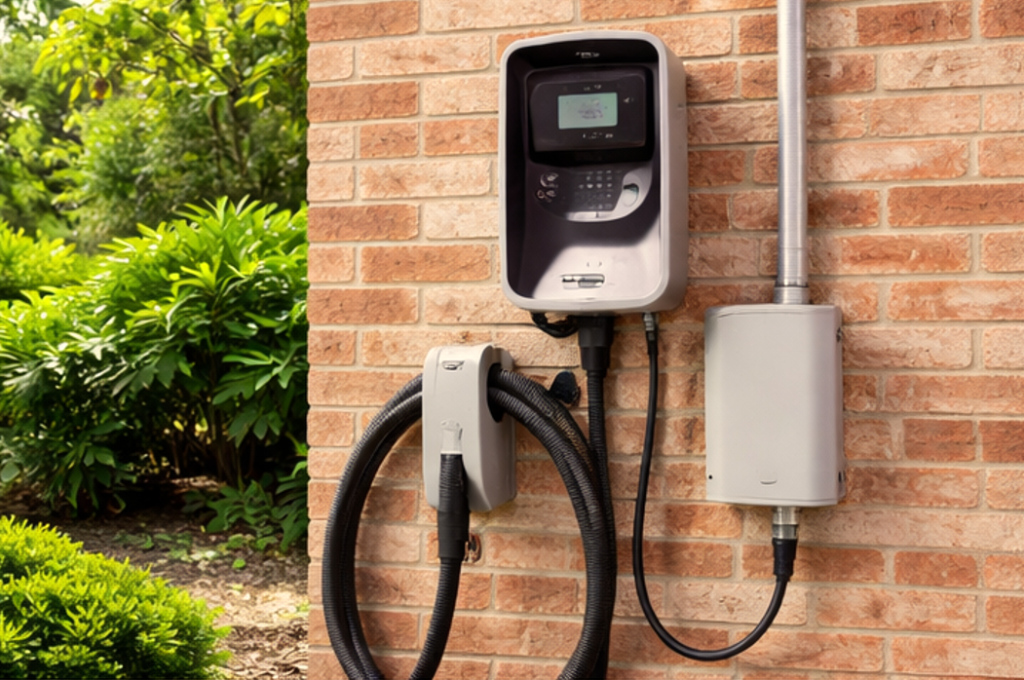
Houston weather includes high humidity, heat, and seasonal storms. Outdoor installations must therefore use weather-resistant equipment and sealed conduit systems.
Professional installers usually follow several protective practices.
| Protection Feature | Purpose |
|---|---|
| Weather-rated charger housing | Protects internal electronics |
| Sealed conduit connections | Prevents moisture entry |
| Elevated mounting position | Reduces flood exposure |
Outdoor chargers should always meet manufacturer weather ratings. Proper installation helps prevent corrosion and electrical faults caused by moisture.
Image placeholder: Outdoor EV charger installed on an exterior wall with weatherproof conduit.
How Does the Installation Process Work Step by Step?
Installing a home charging system involves several structured steps.
1. Electrical Inspection
The installer evaluates panel capacity, breaker availability, and wiring routes.
2. Circuit Preparation
A dedicated 240-volt circuit is created to power the charger safely.
3. Charger Mounting
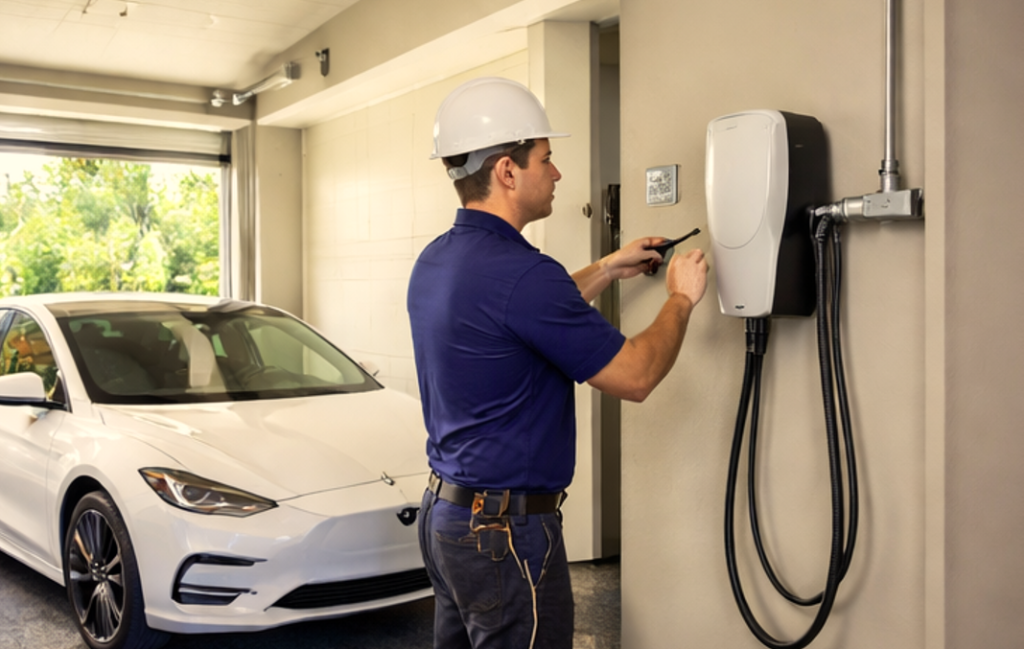
The charger is mounted on the wall using manufacturer brackets.
Image placeholder: Hardwired charger installed in a residential garage.
4. Wiring and Connection
Copper conductors connect the charger to the breaker panel through conduit.
5. Testing and Activation
The charger is tested to verify stable power delivery and vehicle communication.
This process ensures the charger operates safely under continuous load.
What Electrical Rules Apply to EV Charger Circuits?
Electric vehicle chargers operate for long periods. Electrical codes therefore classify them as continuous loads.
Installers follow the NEC 80 percent load rule.
A circuit should only operate at 80 percent of its maximum breaker capacity.
Example calculation:
A 48-amp charger requires a 60-amp breaker because
48 ÷ 0.80 = 60
| Charger Output | Breaker Requirement |
|---|---|
| 32 amps | 40 amp breaker |
| 40 amps | 50 amp breaker |
| 48 amps | 60 amp breaker |
This rule prevents overheating during extended charging sessions.
What Installation Challenges Do Houston Homes Often Have?
Experience from local projects reveals several common challenges.
In many recent installations in Katy and The Woodlands, electricians noticed that homes built between 1985 and 2005 often include 150-amp panels already supporting HVAC systems and electric dryers.
Adding EV charging sometimes pushes the electrical load close to panel capacity.
Instead of replacing the entire panel, installers frequently use load management devices that temporarily reduce charging power when other appliances operate.
This solution allows safe installation while avoiding costly electrical upgrades.
Real installation experience like this helps ensure the charging system operates reliably under everyday conditions.
Which EV Chargers Are Most Suitable for Houston Homes?
Different chargers offer different benefits depending on vehicle type and homeowner preferences.
| Charger Brand | Key Advantage | Best For |
|---|---|---|
| Tesla Wall Connector | Optimized Tesla compatibility | Tesla owners |
| ChargePoint Home Flex | Adjustable amperage | Flexible installations |
| JuiceBox | Mobile energy monitoring | Smart energy tracking |
Homeowners should consider electrical capacity, vehicle compatibility, and smart features before choosing a charger.
Pros and Cons of Installing a Home EV Charger
Pros
Faster charging compared with standard outlets
Convenient overnight charging
Supports daily commuting needs
Compatible with most modern EV models
Cons
Requires professional electrical installation
Older homes may require panel upgrades
Higher initial cost than portable chargers
Why Is My EV Charger Charging Slowly at Home?
Charging performance issues sometimes occur after installation. Most problems have straightforward solutions.
Charger Not Powering On
Check the breaker panel to confirm the circuit has not tripped. Verify that the charger indicator lights are active.
Slow Charging Speed
Check charger amperage settings and confirm the vehicle supports the selected charging rate.
Breaker Trips During Charging
Stop charging immediately and inspect the circuit breaker rating. Repeated breaker trips often indicate circuit overload.
Professional electricians should inspect wiring if the issue continues.
Is Level 2 Home Charging Still Recommended in 2026?
Home charging technology continues to improve. Smart chargers now offer mobile apps, energy monitoring, and scheduled charging features.
Despite these advancements, Level 2 charging remains the most practical residential solution for most drivers.
Public fast chargers are useful for travel. Daily charging, however, works best at home.
For many EV owners, Level 2 EV Charger Installation Houston provides the best balance between charging speed, installation cost, and long-term convenience.
Safety and Compliance Considerations
Electrical safety is essential when installing EV charging equipment.
Professional installers typically follow several safety practices.
- Dedicated circuits for chargers
- Proper breaker sizing
- Weather-rated equipment for outdoor installations
- Electrical inspections after installation
Homeowners should avoid attempting complex electrical work without training. High-voltage circuits require specialized tools and experience.
When installed correctly, Level 2 EV Charger Installation Houston provides safe and reliable charging for everyday EV use.