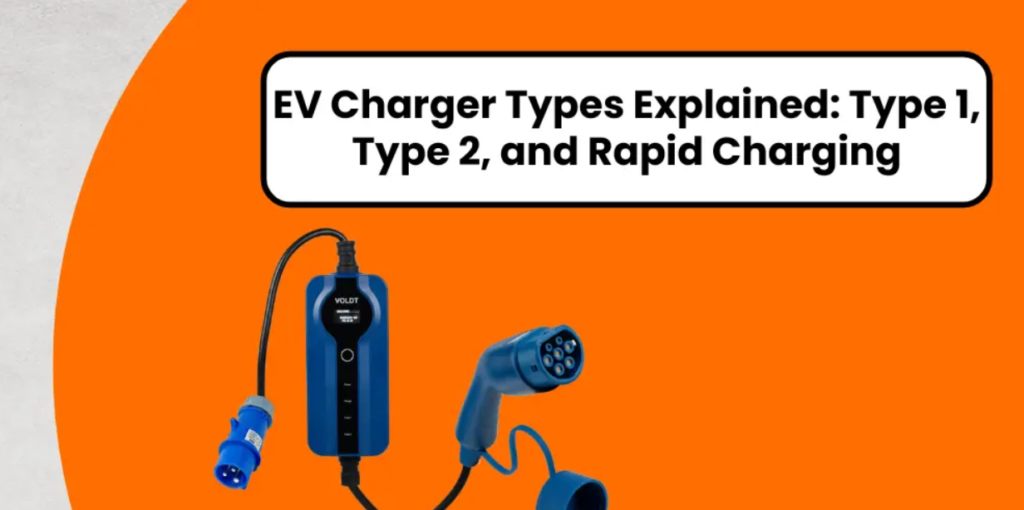
If you just bought an electric vehicle in Houston — or you’re about to — you’ve probably already run into a wall of confusing terminology. Level 1, Level 2, DC fast charging, EVSE, smart chargers, hardwired, plug-in, J1772, NACS. It’s a lot.
This guide cuts through all of it. We explain every EV charger type in plain English, compare them side by side, tell you what each one costs to install in Houston, and point you to the deeper guides you need once you’ve picked your direction.
By the time you finish reading, you’ll know exactly which charger type fits your car, your home, and your budget — and you’ll be ready to get it installed.
Quick Comparison: All EV Charger Types at a Glance
Use this table to get your bearings. The full breakdown for each type follows below.
| Feature | Level 1 | Level 2 | DC Fast Charger | Smart Charger |
| Power output | 1.4 kW | 7–19 kW | 50–350 kW | 7–19 kW |
| Miles per hour | 3–5 miles | 15–30 miles | 100–200 miles | 15–30 miles |
| Full charge time | 20–40 hrs | 4–8 hrs | 20–60 min | 4–8 hrs |
| Install cost | $0–$300 | $500–$2,000 | $10,000–$50,000 | $600–$2,500 |
| Best for | Occasional use | Daily home charging | Commercial/public | Smart home users |
| Permit needed? | Rarely | Usually yes | Always | Usually yes |
Level 1 EV Chargers: The Slow but Simple Option
What Is a Level 1 Charger?
A Level 1 charger is the most basic form of EV charging. It uses a standard 120-volt household outlet — the same kind that powers your phone charger or toaster — and plugs directly into your car using the charging cable that comes in the box when you buy an EV.
There is no installation required. You plug one end into the wall and the other end into your car. That’s it. This is why Level 1 is sometimes called “trickle charging” — it works, but it’s slow.
How Fast Does Level 1 Charge?
Level 1 chargers deliver about 1.4 kilowatts of power, which translates to roughly 3 to 5 miles of range per hour of charging. For context:
- A 60 kWh battery (like a standard Chevy Bolt) takes 40+ hours to charge from empty
- A 100 kWh battery (like a long-range Tesla Model S) could take 70+ hours
- Overnight charging (8 hours) gives you roughly 25–40 miles of range
For most Houston drivers, that’s enough for daily commutes — the average Houstonian drives about 35 miles per day. But if you drive more than that, have multiple EVs, or forget to plug in one night, Level 1 will leave you short.
Who Should Use Level 1?
Level 1 makes the most sense if:
- You drive fewer than 30 miles per day
- You’re a second-car situation where the EV isn’t your primary vehicle
- You’re renting and can’t make electrical upgrades
- You want zero upfront cost while you figure out your setup
It’s worth noting that many Houston EV owners start with Level 1 and upgrade within 6 months. Once the slow charging gets frustrating — and it will — most people move to Level 2.
Level 1 in Houston: Any Special Considerations?
Houston’s heat matters here. Charging in extreme temperatures (above 95°F) slightly reduces efficiency, and parking your car in a hot garage can affect battery conditioning. Level 1’s slower speeds mean your car spends more time sitting in that heat. This is a minor factor, but it’s one reason Houston EV owners tend to prefer Level 2.
Level 2 EV Chargers: The Gold Standard for Home Charging
What Is a Level 2 Charger?
Level 2 is the EV charger type you see most often in homes, apartment complexes, workplaces, and public parking garages. It runs on 240-volt power — the same voltage that powers your clothes dryer or electric range — and charges your car 5 to 8 times faster than Level 1.
Unlike Level 1, Level 2 does require professional installation. You need a dedicated 240V circuit run to your garage or parking area, and the charger unit itself (called an EVSE — Electric Vehicle Supply Equipment) gets mounted on the wall.
This is what the vast majority of Houston homeowners choose, and for good reason. To understand the full installation process, see our detailed guide: How Long Does EV Charger Installation Take in Houston?
How Fast Does Level 2 Charge?
Speed depends on two things: the charger’s output (measured in kilowatts) and your car’s onboard charger capacity. Most home Level 2 chargers fall in the 7–11 kW range, with some reaching 19 kW for compatible vehicles.
- 7 kW charger: roughly 20–25 miles of range per hour
- 11 kW charger: roughly 30–35 miles of range per hour
- 19 kW charger: roughly 50+ miles of range per hour (car must support it)
In practical terms, a fully depleted 60 kWh battery charges in 4–8 hours on Level 2. Plug in when you get home at 7pm, wake up fully charged. That’s the daily rhythm most EV owners settle into.
Level 2 Installation: What It Takes in Houston
Installing a Level 2 charger in a Houston home typically involves:
- Running a 240V circuit from your electrical panel to the charging location
- Installing a 40–50 amp breaker (60 amp for higher-powered units)
- Mounting the EVSE unit on the wall
- Pulling an electrical permit with the City of Houston or relevant municipality
The permit part trips a lot of people up. Houston requires a permit for new 240V circuits, and skipping it creates liability and resale complications. We cover this in full detail here: EV Charger Permit Houston — Complete 2026 Guide
Total installation cost in Houston typically runs between $500 and $2,000, depending on panel distance, panel capacity, and whether your panel needs an upgrade. For a full breakdown: EV Charger Installation Cost in Houston
Hardwired vs Plug-In Level 2: Which Should You Choose?
Level 2 chargers come in two mounting styles. Hardwired chargers are permanently wired into your electrical system — no outlet involved. Plug-in chargers connect to a NEMA 14-50 or NEMA 6-50 outlet that gets installed first, and the charger plugs into it.
- Hardwired: Cleaner look, slightly lower cost long-term, can’t take it with you if you move
- Plug-in: Portable, can be replaced without an electrician, slightly easier install
Most Houston homeowners who plan to stay in their home choose hardwired. Renters or those who travel frequently often prefer plug-in for flexibility.
Popular Level 2 Charger Brands
The most common brands we install in Houston homes include:
- ChargePoint Home Flex: Highly adjustable (16–50 amp), app-controlled, works with all EVs — one of the most popular choices
- Tesla Wall Connector: Optimized for Tesla vehicles, can share power between multiple Teslas. See our full guide: Tesla Charger Installation Houston
- Enel X JuiceBox: Smart features, good app, competitive pricing
- Grizzl-E: Rugged, weatherproof, no-frills option that performs reliably in Houston’s climate
DC Fast Chargers: Maximum Speed, But Not for Most Homes
What Is DC Fast Charging?
DC fast charging — also called Level 3 charging — is the technology you see at Tesla Superchargers, Electrify America stations, and ChargePoint Express units along Houston highways. Instead of sending AC power to your car and letting the onboard charger convert it, DC fast chargers deliver direct current straight to the battery, bypassing that conversion step entirely.
The result is dramatically faster charging: 20 to 60 minutes for an 80% charge on most modern EVs, compared to 4–8 hours on Level 2.
How Fast Is DC Fast Charging?
- 50 kW units: roughly 100–150 miles of range in 30–40 minutes
- 150 kW units: roughly 150–200 miles in 20–30 minutes
- 350 kW units: over 200 miles in under 20 minutes (for compatible vehicles like Hyundai Ioniq 6, Porsche Taycan)
Note that charging slows significantly above 80% state of charge — this is intentional battery protection. For road trips, the standard strategy is to charge to 80% and drive to the next station.
Can You Install DC Fast Charging at Home?
Technically yes — practically, almost never. DC fast chargers require three-phase 480V electrical service, which most Houston homes don’t have. The infrastructure cost alone (transformer upgrades, utility work, high-capacity wiring) typically runs $10,000 to $50,000 or more before you even buy the equipment.
For residential use, Level 2 is the right call. DC fast charging is designed for commercial properties, fleet depots, highway corridors, and retail locations where turnover matters. If you’re a business owner looking to add EV charging infrastructure, contact us for a commercial assessment.
DC Fast Charging in Houston: Where to Find It
Houston has a solid and growing DC fast charging network. Major corridors like I-10, I-45, US-59, and Beltway 8 all have fast charging stations, and newer retail centers like H-E-B anchored developments have been adding Electrify America bays. For a full map of charging locations near you, see our local guide: EV Charging Stations in Houston
Smart EV Chargers: Level 2 With Connected Intelligence
What Makes a Charger ‘Smart’?
A smart charger is a Level 2 charger with Wi-Fi or Bluetooth connectivity, a companion app, and software features that let you monitor and control charging from your phone. The hardware is essentially the same as a standard Level 2 charger — the intelligence is in the software layer.
Key smart charger features include:
- Scheduled charging: Set your car to charge during off-peak TDU hours (typically 9pm–6am in Houston) when electricity rates are lowest
- Energy monitoring: Track exactly how much electricity your car uses and what it costs
- Remote start/stop: Start or pause a charge session from anywhere via app
- Charge level limits: Cap charging at 80% for daily use to extend battery longevity
- Load balancing: Some units (like Tesla Wall Connector) share available power across multiple chargers
- Utility rebate compatibility: Many Houston-area utility programs require a smart charger to qualify for rebates
Smart Chargers and Houston Energy Rates
This is where smart chargers pay for themselves in Houston. CenterPoint Energy and most retail electric providers in the ERCOT market offer time-of-use (TOU) pricing or off-peak incentives. Charging during off-peak hours (typically overnight) can cut your EV electricity cost by 30–50% compared to charging during peak afternoon hours.
A basic Level 2 charger will charge whenever you plug it in. A smart charger delays the session automatically until your cheapest rate window opens. Over a year of daily charging, that difference can add up to $200–$400 in savings for a typical Houston household.
There are also rebate programs that require smart chargers. For everything you need to know about Houston-area EV incentives: EV Charger Rebates in Texas
Smart vs Standard Level 2: Is the Premium Worth It?
Smart chargers typically cost $100–$400 more than equivalent standard Level 2 units. Here’s how to think about the tradeoff:
- If you have time-of-use electricity pricing → smart charger pays for itself quickly
- If you’re applying for utility rebates → smart charger may be required
- If you want usage monitoring for tax credits → smart charger simplifies record-keeping
- If you have a simple setup and just want reliable charging → standard Level 2 works fine
For most Houston homeowners in 2026, we lean toward recommending smart chargers as the default. The premium is modest, the energy savings are real, and the utility rebate programs increasingly favor or require them.
Which EV Charger Type Is Right for Your Houston Home?
The Simple Decision Framework
Answer these three questions:
- How many miles do you drive daily? Under 30 miles → Level 1 may be enough. Over 30 miles → go Level 2.
- Do you have a garage or dedicated parking? Yes → Level 2 with hardwired install. Condo/apartment → check building options or plug-in Level 2.
- Do you care about energy costs? Yes → smart charger. No → standard Level 2 is fine.
The most common setup for a Houston homeowner with a single EV: a Level 2 smart charger, hardwired, 40-amp circuit. This covers 99% of daily driving needs, charges overnight while rates are low, and installs in a single day.
For homes with two EVs, the calculation shifts slightly — you’ll want to think about load sharing or a dedicated circuit for each vehicle. We cover that in our full installation guide: Home EV Charger Installation in Houston, TX
What About Future EV Technology?
The charger you install today should still be relevant in 5–10 years. A few things worth knowing:
- Bidirectional charging (V2H/V2G): Some newer EVs can send power back to your home or the grid. This requires a compatible bidirectional charger — standard units don’t support it. If your EV supports it (Ford F-150 Lightning, some Nissan LEAFs), this may factor into your charger choice.
- NACS connector adoption: The Tesla-designed NACS connector is now being adopted by most major automakers. If your new EV uses NACS, ensure your charger is compatible.
- Solar integration: Pairing your charger with rooftop solar can dramatically reduce charging costs. Smart chargers with solar integration APIs are becoming more common.
EV Charger Installation in Houston: What to Expect
The Installation Process
Most Level 2 installations in the Houston area follow the same basic steps, whether you’re in River Oaks, Katy, Sugar Land, The Woodlands, or Pearland:
- 1. Site assessment: An electrician evaluates your panel capacity, garage layout, and optimal charger placement
- 2. Permit application: Required for new 240V circuits in Harris County and surrounding areas
- 3. Panel work: Adding a 40–50 amp breaker, or upgrading the panel if it’s at capacity
- 4. Wire run: Running conduit from the panel to the charging location
- 5. Charger mount: Installing and testing the EVSE unit
- 6. Inspection: City inspector signs off on the permit
The whole process typically takes 1 to 2 days for straightforward installations. For homes with older panels or longer cable runs, timeline can extend. Full details: How Long Does EV Charger Installation Take in Houston?
Do You Need a Permit?
Yes — in virtually all cases within Houston city limits and surrounding Harris County municipalities. The permit requirement exists to ensure safe installation and protects you from insurance and liability issues. Our licensed electricians handle the permitting process end to end. More on this: EV Charger Permit Houston — Complete 2026 Guide
What Does EV Charger Installation Cost in Houston?
Costs vary based on your home’s electrical setup, the charger model, and how far the circuit needs to run. In 2026, typical Houston installation costs range from $500 to $2,000 for a standard Level 2 installation. Homes that need panel upgrades may see higher totals.
Read our complete cost breakdown — including what drives costs up, what you can do to reduce them, and what rebates are available: EV Charger Installation Cost in Houston
Frequently Asked Questions About EV Charger Types
Can I use any Level 2 charger with any EV?
Almost all Level 2 chargers use the SAE J1772 connector, which works with every non-Tesla EV sold in the US. Tesla vehicles come with an adapter that lets them use J1772 chargers as well. Newer EVs using the NACS (North American Charging Standard) connector can typically use Level 2 chargers with a simple adapter. When in doubt, check your vehicle manual or ask us before purchasing a unit.
Will my EV charge faster with a more powerful charger?
Only up to your car’s onboard charger limit. Every EV has a maximum AC charging rate — for example, a Toyota bZ4X accepts up to 6.6 kW, while a Tesla Model 3 Long Range accepts up to 11.5 kW. Buying a 19 kW charger won’t help a car that maxes out at 7 kW. Always check your vehicle’s onboard charger spec before purchasing.
Is a Level 2 charger safe to leave plugged in overnight?
Yes. Modern EVs and EVSE units have multiple built-in safety protections — the car communicates with the charger continuously and stops drawing power when the battery is full. Leaving your car plugged in overnight is standard practice and perfectly safe. In fact, smart chargers are designed specifically for overnight charging sessions.
What’s the difference between EVSE and EV charger?
Technically, the ‘charger’ is the onboard electronics inside your car that converts AC power to DC for the battery. What we call a ‘home charger’ is actually an EVSE — Electric Vehicle Supply Equipment — which safely delivers power to the car’s onboard charger. In everyday conversation, ‘EV charger’ and ‘EVSE’ are used interchangeably, including throughout this site.
Do I need to upgrade my electrical panel for Level 2?
Not always. Most Houston homes built after 1990 have a 200-amp panel with room for a 40–50 amp circuit. Older homes or homes already running heavy electrical loads (multiple AC units, electric pool heaters, electric dryers) may be at capacity. Your electrician will assess this during the site visit. Panel upgrades, when needed, add $1,000–$3,500 to the project. See our full cost guide for a breakdown.
Ready to Install? Here’s Your Next Step
Now that you understand the different EV charger types, the path forward is straightforward:
- Most Houston homeowners: go with a Level 2 smart charger, hardwired by a licensed electrician
- Tesla owners: consider the Tesla Wall Connector — it’s optimized for your vehicle
- Looking at costs first: see our complete installation cost guide
- Concerned about permits: read the Houston permit guide before you start
We install EV chargers across the Houston metro area — Harris County, Fort Bend County, Montgomery County, Brazoria County, and Galveston County. Our licensed electricians handle everything from permit to inspection.
Get a no-obligation quote today: Request a Free EV Charger Installation Quote
Related Guides on This Site
EV Charger Installation Cost in Houston
EV Charger Permit Houston — Complete 2026 Guide
How Long Does EV Charger Installation Take in Houston?
Tesla Charger Installation Houston
Level 2 EV Charger Installation Houston Home 2026
EV Charger Service Houston: Repair, Maintenance & Troubleshooting